




Price: $748.99 $549.99
(as of 2026-10-20 20:33 GMT+0000 – Details)

Mini‑LED Backlight and QLED Color
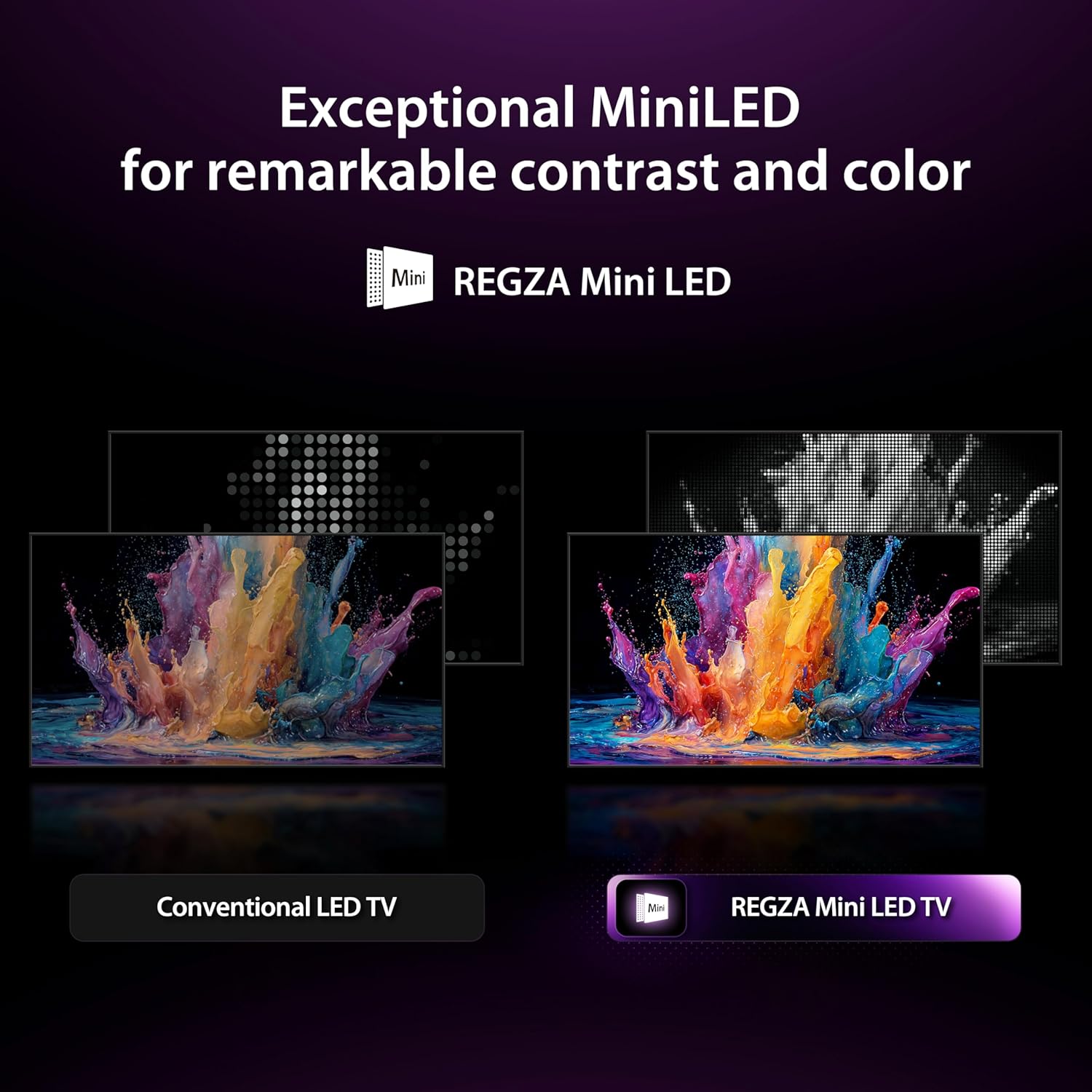
The Mini‑LED backlight uses thousands of precision‑controlled LEDs arranged in a full‑array local‑dimming matrix. This architecture lets the TV dim individual zones independently, producing deeper blacks and brighter highlights than conventional edge‑lit panels. Combined with Toshiba’s QLED layer, the panel can render over a billion color shades while maintaining hue accuracy across the luminance range. In practice, viewers see more detail in shadowed scenes and specular highlights without the halo artifacts that sometimes appear on lower‑zone displays. The trade‑off is that the number of dimming zones, while high, is still finite; extremely fine gradients may show slight banding in very dark content. The local‑dimming zone count is not disclosed, so exact contrast performance varies by content.
REGZA Engine ZRi Gen3 AI Processing
The REGZA Engine ZRi Gen3 applies scene‑by‑scene AI analysis to both picture and sound pipelines. Trained by Toshiba engineers in Japan, the engine identifies content type — such as film, sports, or gaming — and adjusts contrast, sharpness, color temperature, and noise reduction accordingly. It also balances audio equalization, directing dialogue to the clear‑direct speakers while routing low‑frequency effects to the integrated bass woofer. The result is a more natural image that avoids over‑sharpening artifacts and a soundstage that feels cohesive rather than artificially boosted. Because the processing is performed in real time, there is no user‑adjustable profile; the TV decides the optimal settings automatically. Users cannot manually select a picture mode for the AI engine, which may frustrate enthusiasts who prefer custom calibration.
REGZA Power Audio Pro with Bass Woofer
REGZA Power Audio Pro pairs a dedicated bass woofer with two clear‑direct mid‑range drivers, delivering a 2.1‑channel layout without external speakers. The woofer is tuned to reproduce frequencies down to roughly 40 Hz, giving explosions and musical low‑end a physical presence that can be felt in a typical living‑room size. The amplifiers are calibrated to keep distortion low even at high output, while the direct‑radiating mids preserve vocal intelligibility. For users who prefer a more neutral balance, the TV offers a basic EQ preset, but the default profile leans toward a cinematic emphasis. Limitation: the system cannot match a full‑size soundbar for dynamic range or spatial imaging. The system lacks a dedicated subwoofer output, limiting expansion to external bass modules.
Fire TV Platform and Alexa Voice Control
Fire TV serves as the operating system, presenting live‑TV channels, streaming apps, and a unified channel guide on a single home screen. Navigation is handled by the included remote or by voice through the built‑in Alexa microphone; pressing the microphone button activates the assistant for content search, playback control, smart‑home commands, and informational queries such as sports scores or timers. The platform receives regular over‑the‑air updates, adding new services and UI refinements without user intervention. However, the ecosystem is tied to Amazon’s services; some third‑party apps may appear later than on competing platforms, and the voice assistant cannot control devices that lack Alexa integration. The remote includes dedicated shortcut buttons for popular streaming services, streamlining access.
Gaming Performance: 144 Hz, VRR, and ALLM
The panel’s native 144 Hz refresh rate, combined with Game Mode Pro, targets competitive gamers who need minimal input lag. AMD FreeSync Premium and variable refresh rate (VRR) up to 144 Hz synchronize the display’s frame timing with compatible GPUs, eliminating screen tearing and stutter. Auto Low Latency Mode (ALLM) automatically switches the TV into its lowest‑latency picture preset when a game signal is detected, removing the need for manual menu changes. These features work over HDMI 2.1 ports, which also carry 4K @ 144 Hz bandwidth. A practical consideration: the TV’s local‑dimming algorithm may introduce slight blooming around bright HUD elements in very dark scenes, which can be mitigated by disabling local dimming in the game preset. HDMI 2.1 bandwidth also supports 4K @ 120 Hz with HDR, useful for current‑gen consoles.
HDR Support, AI Light Sensor, and Design
Total HDR Solution Pro aggregates Dolby Vision IQ, HDR10+, HDR10+ Adaptive, and HLG support, allowing the TV to decode the most common high‑dynamic‑range formats and apply scene‑by‑scene tone mapping. Dolby Vision IQ adds ambient‑light metadata so the picture adapts to room brightness, while HDR10+ Adaptive performs a similar function for the open‑standard format. The AI Light Sensor Pro measures ambient illumination and adjusts peak brightness and color temperature in real time, reducing eye strain during extended viewing. The chassis follows a minimalist Japanese design language: thin bezels, a low‑profile stand, and a matte finish that blends into modern interiors. The only limitation is that the stand does not swivel, so placement flexibility is limited to the fixed orientation. The AI Light Sensor can be disabled in the settings menu for users who prefer a fixed brightness curve.