


Price: $1,798.00
(as of 2026-10-20 21:14 GMT+0000 – Details)

A Gallery-Inspired Presence
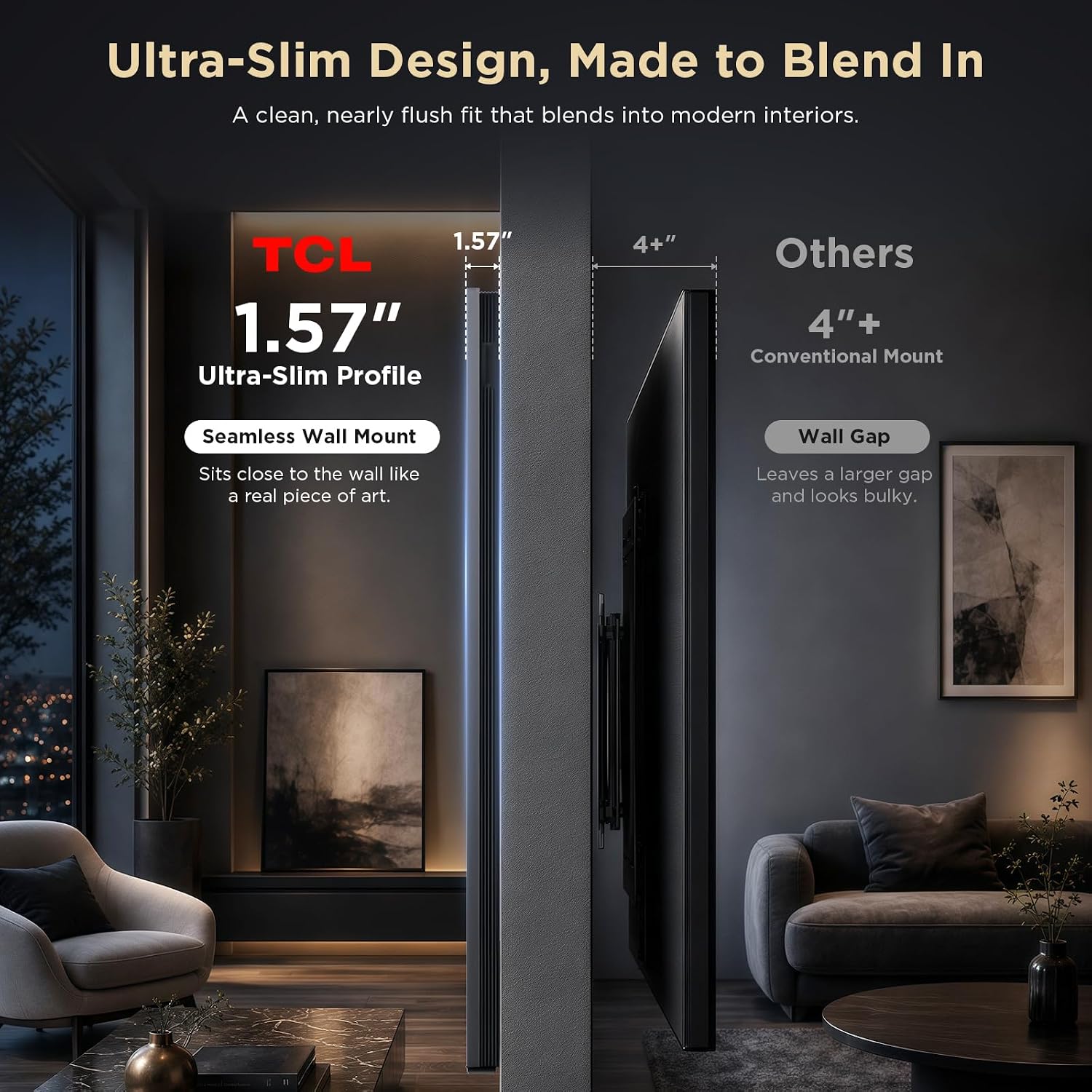
The TCL 85A400U Designer Series QD-Mini LED TV is designed as much for its room appearance as for picture performance. Its 1.57-inch ultra-slim profile and approximately 0.12-inch near-flush wall gap allow the 85-inch set to sit close to a mounted wall, reducing the visual impression of a bulky screen and supporting a gallery-like, picture-frame presentation. The slim chassis is especially useful when the television is intended to become part of the décor rather than sit on a conspicuous stand. That does not change the screen’s substantial 85-inch footprint, however, so placement, viewing distance, and available wall space still need to suit the room.
Mini LED Picture Performance
Picture performance centers on 1008 precise Mini LED dimming zones and a peak brightness figure of up to HDR 2500 nits. Local dimming is intended to adjust different areas of the backlight independently, helping bright highlights stand out while preserving deeper blacks in darker portions of the same image. That capability is particularly relevant to movies, nighttime scenes, and other HDR content with a mixture of very bright and very dark elements. The 2500-nit figure is an up-to value rather than a guarantee of sustained brightness in every scene, and the description provides no contrast-ratio measurement. Nevertheless, the combination of extensive zone control and high peak brightness gives the television a clearly specified foundation for more dimensional imagery.
Vibrant Color and Reduced Reflection
Color is handled through QLED technology, 93% DCI-P3 coverage, and the HVA Pro Panel, while ultra-low reflection is intended to limit distracting glare from surrounding room light. Broad DCI-P3 coverage means the television can reproduce a substantial portion of the color space used for digital cinema, supporting more saturated and varied shades in compatible content. Coverage alone does not establish color accuracy, calibration, or the volume of every color the set can display, and no lab results are supplied. The anti-reflection treatment is most useful in bright living spaces where a conventional glossy screen could make dark scenes appear washed out. Together, the color and surface features are presented as a way to retain vivid imagery without relying on a completely darkened viewing room.
High-Refresh Gaming Features
The gaming specification combines native 4K 144Hz operation with an up-to-1080p 288Hz Game Accelerator mode. VRR and FreeSync Premium Pro are included to help synchronize the television’s refresh timing with compatible game consoles or PCs, while ALLM can automatically enable a low-latency mode when the content and connected device support it. The 288Hz option applies at 1080p rather than 4K, so the highest refresh rate comes with a lower source resolution. These features are intended to keep fast racing, sports, and action scenes smoother while reducing visible tearing and inconsistent frame pacing. Actual benefits depend on the game, graphics settings, source hardware, and whether those devices support the relevant high-refresh and synchronization modes. No exact input-lag measurement is provided.
Art and Ambient Display Options
When no program is on screen, Art Gallery, Digital Art, Art Memory, and Ambient Mode turn the television into a decorative display. These features can present artwork, favorite photographs, or calming scenes, allowing the large screen to blend into the room when it is not being used for conventional viewing. Art Memory is presented as a way to retain favored visuals, while Ambient Mode offers an alternative for creating a subdued background presence. The description does not identify the available art catalog, explain whether additional images can be uploaded, or specify any storage and format requirements. Users considering the television as a digital display should therefore view these functions as a strong design feature while recognizing that the range of supplied content remains unspecified.
Automatic Scene Optimization
The TSR AiPQ Processor is responsible for automatically adjusting clarity, contrast, color, and motion according to the content on screen. Its practical purpose is to reduce the need for continual manual picture changes when moving between films, live programming, games, and streaming content. This is particularly useful in a large living-room television that may handle several source types over the course of a day. The supplied information does not provide processing benchmarks, supported picture settings, or a direct comparison with manual calibration. It also does not imply that automated optimization will produce the same result in every room or for every source. The processor is best understood as a convenience-oriented system that continuously fine-tunes the picture around the television’s core Mini LED and QLED capabilities.
Built-In ONKYO Audio
Sound comes from an ONKYO 2.0 Hi-Fi system with 20W total output, DTS:X, and DTS Virtual:X. The stereo configuration provides a straightforward way to watch films and streaming programs without adding separate speakers, while the listed audio processing is intended to improve dialogue clarity and create a wider soundstage. Virtual processing can give compatible content a more spacious presentation, although it does not create the same output as a physical multichannel speaker system and will be affected by room size, furnishings, and placement. The stated 20W total also places expectations on an integrated solution focused on convenience and general intelligibility. For viewers seeking substantially greater output or a dedicated home-theater soundstage, the built-in system would function alongside external audio rather than eliminate the need for it.
Google TV and Connected Entertainment
Google TV consolidates movies, shows, and apps into a unified interface, while Google Cast, AirPlay 2, voice control, dual-band Wi-Fi, and Bluetooth 5.4 provide several ways to share and connect content. Casting and AirPlay support are useful for sending material from compatible phones, tablets, or computers, and dual-band Wi-Fi offers more flexibility in how the television connects to a home network. Bluetooth 5.4 adds short-range connectivity for compatible accessories, although their precise support is not detailed. The description also does not list the complete application catalog, supported streaming formats, connectivity ports, or specific voice-assistant capabilities. Access to premium films, shows, or other subscription content may still depend on the chosen provider. Overall, the platform is positioned as a simple central hub for everyday streaming and device sharing.