



Price: $799.99
(as of 2026-10-20 22:48 GMT+0000 – Details)

Hisense 75E7SF Overview
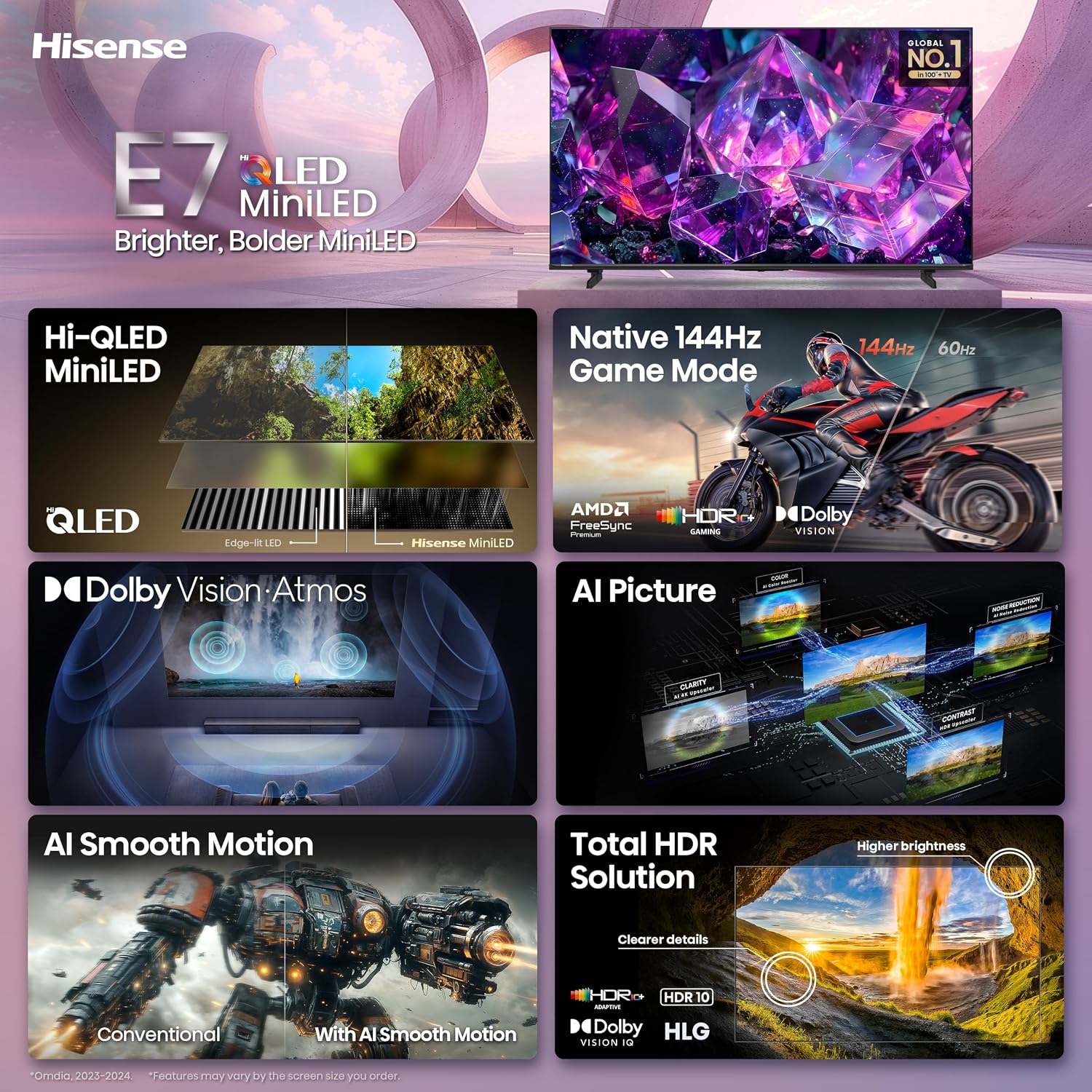
The Hisense 75E7SF brings a 75-inch Cinema Series display, Mini-LED backlighting, and a high-refresh gaming feature set to the 2026 E7 line. Its central appeal is the combination of local contrast control from thousands of light zones and native 144Hz performance, supported by AI picture processing, multiple HDR formats, and Dolby Atmos. The same feature set is designed to serve different content types: movies benefit from precise shadow and highlight control, live sports from motion handling and adaptive sound, and games from a high native refresh rate. As a Fire TV, it also places streaming and voice control within the television, while Alexa+ support is included in the supplied specification.
Mini-LED Contrast and Adaptive Brightness
Mini-LED is the foundation of the E7SF’s picture quality. Rather than relying on one uniform backlight, the panel uses thousands of precise light zones, allowing the television to darken areas containing shadow detail while pushing brighter areas toward stronger highlights. The title identifies this as FALD, or full-array local dimming, matching the description of precisely controlled backlighting across the screen. That local control is the practical basis for deeper blacks, improved contrast, and greater visible detail. It is particularly relevant to mixed content such as movies, where dark scenes can sit beside bright windows or effects. However, the supplied information provides no measured contrast ratio, peak brightness, or exact zone count, so the degree of the advantage cannot be quantified.
144Hz, MEMC, and High-Speed Motion
The native 144Hz Game Mode is the most distinctive specification for fast-moving content. A 144Hz panel can present high-frame-rate game feeds more fluidly, reducing visible motion blur and making quick movement easier to track. The description also notes that this helps with rapid camera shots in shows and films, where high refresh can improve clarity even when the source is not a game. MEMC and AI Smooth Motion extend that benefit by sharpening and smoothing scenes that are not natively high-frame-rate. The practical caveat is that motion enhancement can make some footage look interpolated, while the supplied material offers no measured input lag, so responsiveness should not be treated as a quantified gaming guarantee.
AI Picture Processing and Upscaling
AI Picture is intended to reduce the need for manual adjustment. According to the supplied description, the processor analyzes content scene by scene and optimizes brightness, contrast, and color in real time, with the goal of producing a clearer and more natural image. This can be useful when switching among films, streamed shows, sports, and games because the television is said to respond to changing content rather than remain locked to one static preset. The AI 4K upscaler has a related job: using deep learning to sharpen details, reconstruct textures, and reduce noise in lower-resolution sources. Upscaling can make older or compressed programming appear cleaner on a 4K panel, although it cannot recover source detail that was never captured, making native 4K content the ideal case.
Adaptive Viewing, Cinema, and Sound
Two other AI-driven features tailor the television to viewing conditions and program type. The AI light sensor detects ambient light and adjusts the backlight in real time, which should help maintain comfortable brightness and visible contrast whether content is viewed at night or during the day. AI Sports Mode is described as recognizing sports content and changing both picture and sound settings, including clearer action, smoother motion, and boosted crowd audio. In practical use, these modes offer a convenient starting point for events where picture and audio need to change quickly. Their effectiveness still depends on the accuracy of content detection and the television’s speakers or connected audio system; the description supplies no sensor details, processing measurements, or audio-output specifications.
Total HDR Solution
The E7SF’s Total HDR Solution covers Dolby Vision IQ, HDR10+ Adaptive, HDR10, and HLG. This range provides several compatible paths for HDR content, depending on the source and streaming service. Dolby Vision IQ is listed alongside Dolby Vision support and is intended to refine the HDR presentation, while HDR10+ Adaptive is designed to adapt rendering to the content and viewing environment. The practical benefit is not simply a brighter image, but the possibility of preserving highlight intensity, shadow separation, and color across different kinds of HDR material. The supplied copy does not state measured peak brightness, nit levels, or supported input frame rates, so it is not possible to determine how all four formats perform at 144Hz or how they compare with other televisions.
Filmmaker Mode and Dolby Atmos
For cinema use, Filmmaker Mode provides a clear alternative to the automatic processing modes. It is described as preserving the original aspect ratio, color, frame rate, and sound, allowing movies to be presented with fewer television-driven adjustments. Dolby Atmos support then supplies immersive audio intended to create a larger, more enveloping soundstage. Together, the picture and audio features target a more cinema-like presentation at home, but the two goals are distinct: Filmmaker Mode prioritizes fidelity, whereas AI Picture and AI Sports Mode prioritize automatic optimization. The description does not identify the speaker configuration, channel count, or total power, so Dolby Atmos capability should not be interpreted as a guarantee of the same immersion that a dedicated surround or height-channel system could provide.
Smart Features and Practical Considerations
The built-in Fire TV makes the E7SF a combined display and streaming platform, and the listed Alexa+ support adds a voice-oriented route for operating smart features. The supplied information does not specify app availability, voice-command coverage, account requirements, or connection options, so those details may need verification before purchase. At 75 inches, the set also requires suitable furniture and enough viewing distance for the large image to be practical in everyday use. Overall, the supplied specification directly targets viewers who want one large screen to handle cinematic HDR, sports, streaming, and high-refresh gaming. Missing information such as price, exact zone count, brightness measurements, input lag, HDMI configuration, speaker specifications, and warranty terms prevents a more complete assessment of value or comparative performance.