
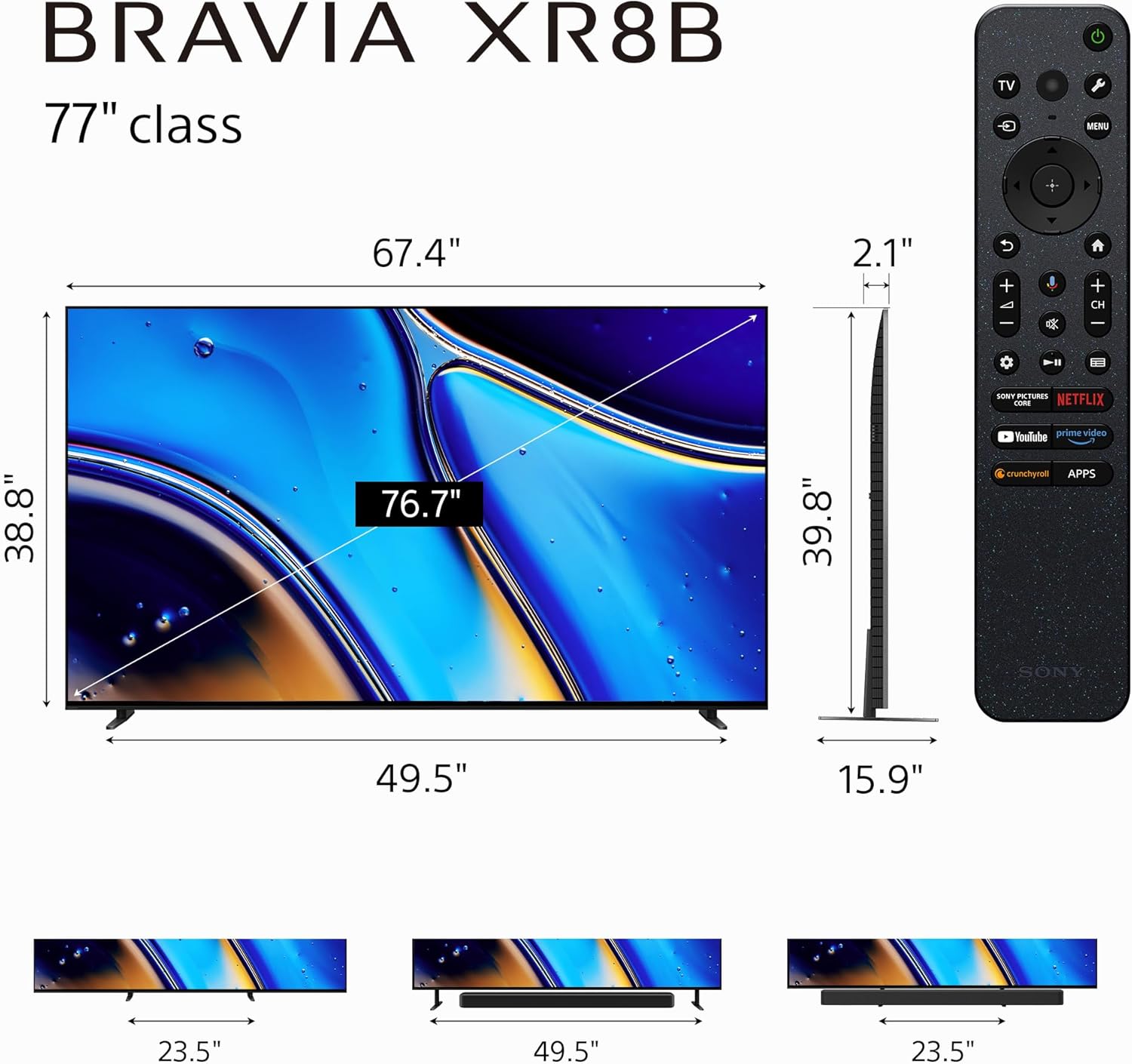


Price: $2,498.00
(as of 2026-10-20 22:45 GMT+0000 – Details)

Pure Black OLED Contrast
The panel uses over eight million self‑lit pixels that can be turned off individually, delivering true black levels alongside high peak brightness. This pixel‑level control eliminates the light‑bleed typical of backlit LCDs, so dark scenes retain detail without a gray veil. In practice, the contrast advantage means shadow‑heavy content such as night‑time cinematography or space documentaries appears with depth that matches the creator’s intent. The limitation is that maximum brightness is still bounded by OLED material limits, so very bright HDR highlights may not reach the same luminance as some high‑end LED models.
XR Processor Real‑Time Enhancement
The XR Processor analyses each frame as it arrives, adjusting color volume, contrast curves, and sharpness on the fly. By cross‑referencing multiple picture elements — such as texture, motion vectors, and luminance — the engine can boost perceived detail without introducing ringing or overshoot. For the viewer this translates to more natural skin tones, richer foliage, and clearer text in on‑screen graphics. The processor’s effectiveness depends on the source quality; heavily compressed streams will still show compression artifacts that the chip cannot fully reconstruct.
Google TV Unified Streaming
Google TV aggregates apps like Netflix, Prime Video, Disney+, YouTube, Apple TV, Crunchyroll and many others into a single home screen, reducing the need to switch inputs. The integrated Google Assistant allows voice search across services, so a request such as “show me sci‑fi movies” returns results from every installed provider. This convenience streamlines content discovery, especially for households with multiple subscriptions. The platform’s responsiveness is tied to the TV’s internal memory and network speed; slower Wi‑Fi can cause noticeable lag when navigating the interface.
Wireless Casting with AirPlay 2 and Google Cast
Support for Apple AirPlay 2 and Google Cast lets phones, tablets, and laptops mirror or stream audio‑video directly to the screen without cables. AirPlay 2 adds multi‑room audio synchronization, while Google Cast works with a broad range of Android and Chrome‑OS devices. In everyday use this means quick sharing of photos, presentations, or a YouTube clip from a mobile device. The feature requires both the TV and the source device to be on the same network, and performance can degrade on congested 2.4 GHz bands.
Studio Calibrated Picture Modes
Dedicated picture presets tuned in collaboration with Netflix and Prime Video aim to reproduce the color space, gamma, and white‑point each service uses for its master files. When selected, these modes bypass generic “vivid” settings and present content closer to the post‑production reference. The practical benefit is a more consistent look across different titles on the same service. However, the modes are locked to those two platforms; other apps will fall back to the TV’s standard picture settings unless manually adjusted.
PlayStation 5 Optimized Gaming
Auto HDR Tone Mapping and Auto Genre Picture Mode detect a PS5 signal and automatically configure HDR luminance mapping and genre‑specific picture parameters (e.g., low latency for shooters, higher contrast for RPGs). This removes the need for manual calibration each time a game launches. The result is reduced input lag and HDR that respects the game’s mastering intent. The features function only when the console outputs a compatible HDMI 2.1 signal; older consoles or non‑HDMI sources will not trigger the automatic modes.
Cinematic HDR and Immersive Audio Formats
The set supports Dolby Vision, Dolby Atmos, IMAX Enhanced, and DTS:X, covering the major premium HDR and object‑based audio standards used by streaming services and Ultra HD Blu‑ray. Dolby Vision adds dynamic metadata for scene‑by‑scene tone mapping, while Atmos and DTS:X place sounds in a three‑dimensional space. IMAX Enhanced certifies that select titles meet specific picture‑and‑sound criteria. The TV’s built‑in speakers act as a sound‑from‑screen transducer, so audio appears to emanate from the image itself, enhancing immersion without external speakers. The audio performance is limited by the physical size of the panel’s actuators; a dedicated soundbar or AV receiver will still provide greater dynamic range and bass extension.
Upscaling, Motion Handling, Design and Sound‑From‑Screen
XR Clear Image up‑scales HD and standard‑definition sources by reconstructing missing detail using the processor’s texture database, making older broadcasts look sharper on the 4K grid. XR OLED Motion inserts black‑frame insertion and motion‑vector interpolation to suppress judder and blur during fast sports or action sequences, preserving clarity without the soap‑opera effect when the feature is tuned conservatively. The chassis adopts a minimal bezel and a low‑profile stand, allowing the screen to blend into modern living‑room aesthetics. Because the panel itself vibrates to produce sound, the acoustic output follows on‑screen movement, creating a cohesive audio‑visual experience that is unique to this architecture.